

Pansies III
Thoughts

Continuing on with my efforts of increased attention towards decreased concern, here’s some more sundry and dubious thoughts. This one covers some ground: Post-Modernity, Captain Beefheart, New Formalism, and more. May the reader pick the flowers and burn the weeds.
The Perfect Word
Frank Zappa and Captain Beefheart used to talk about “the perfect note.” It’s a note that, after a preceding sequence of notes, is chosen perfectly, almost as if it choses itself. The perfect note is a note that couldn’t be any other. Every other choice would be inferior. It could only ever be that one, singular note. That’s the perfect note.
So, we have this model of creation where the aim is to assemble a constellation of materials wherein the perfect choice of material can occur.
We can imagine a poem where a single word is perfect. Any other word would be worse, or even wreck the entire poem. We could even imagine the ideal poem where every word is perfect, and even a single change would grievously harm the whole poem.
We don’t have to imagine very hard, either. We’ve all read poems that use a single word perfectly, or poems that hinge on an individual word or phrase; Or even poems that build up to a single, perfect line.
And so we have ourselves a genuine Artistic Problem: How can we make poems that induce the creation of Perfect Words? Naturally this is very difficult. We would probably make perfect poems all the time if we could.
In lieu of perfection, Novelty is a possibility. The perfect word is when the most befitting choice is made, however less befitting choices can also be made. Using less befitting, inferior choices create inferior works, but when an inferior work is artfully crafted it may result in Novelty, thus remaining of interest to us.
While the novel work may be inferior, it proves distinct. It distinguishes itself from both superior works and mundane works. And because it’s distinct, the novel work (despite its inferiority) serves to fill out our total aesthetic experience. Even though it is not better, it is at least different. The inferior throws the superior into a new relief thus assisting our appreciation of it. The inferior acts as the shadow of the superior.
Of course, there are some who prefer the shadow over the thing itself. The critic is always under self-duress because he is attracted to inferior works of art that require his critique to complete it. The inferior, imperfect, incomplete work of art is in need of the critic’s ability to defend it, propagandize for it, or otherwise fill in the gaps. In this way, the critic is predisposed towards lesser works as a means of self-justification. But I digress.
We crave satisfaction of our total aesthetic experience. Even when we’ve seen “the perfect” we desire to see “the different.” What does X mixed with Y look like? What if A was cast in the form of B? Therefore we experiment, and sometimes we do indeed discover new things; But experimentation almost always bears the marks of desperation.
However, experimentation is necessary because the idea of the Perfect Note or Word is relative (as in relational.) There’s no single, perfect, formulaic construction. The Perfect Note and Perfect Word arise out of their context.
We develop these constellations of materials wherein we can explore and develop the potentialities of words, form, and genre. Our experimentation within these constellations map out the potency of words’ color, rhythm, and meaning. We’re trying to properly demarcate our immediate materials. Since words and times are always changing, this must be done again and again. What was once new is now old and must be made new again. This must be a renewal or a resurrection, but not a return.
The experimental—Novelty—pursues the twin aims of cartography and total aesthetic satisfaction. And if we drop either pursuit, we are deprived of something either way. Pursue only the cartography of perfection and find anorexic homogeneity; Or pursue only aesthetic hedonism and find bizarre, perverse antinomianism. Ironically, no matter the aim, both of these sole pursuits result in the triumph of banality.
Poetry for the People
You hear a great deal about “The People.” Who are these People? I have never met The People.
Also, why do they need poetry? You know a funny thing? The people who keep saying that “The People” need poetry are never “The People.” It’s always the poets saying this.
BREAKING: Local Boondoggle maker exclaims, “The People have been deprived of Boondoggles for too long. Boondoggles for The People!”
More news at eleven.
Naturalism
A kaleidoscope does not help you see, but it is a pleasure to see. It is new and unique sight. It may not be “real” sight, but it pleases us. Should we throw it away because it is not “real?” Or should we have more faith in our instincts and keep it?
Representations are lenses and prisms. They are exaggeration machines. They throw familiar things in new relief and help us see what we could not see before. Representations ought not be censured because they exaggerate.
Now, there is a cult of Naturalism. They tyrannically reject formalism, affectation, and artifice. “The art of Art is hiding art.” A line of verse is never allowed to sound unnatural. Unnatural!? Oh the horror! Someone slip me a fainting couch.
Every line of verse should sound as natural as the unprovoked utterances of a monstrously obese, greasy woman taking a dump in a shit-ridden truck stop bathroom.
But what is a Poem except words at play? When you play, you do weird things, silly things, odd things. Man at play does things outside of the norm. Unnatural things, even.
The mundane, workaday world proceeds according to set rules, but the world of play proceeds along its own established rules. The rules of Play bend the rules of the Mundane.
So I ask, “Is Naturalism any fun to play with?”
Pretense
The ultimate pretension of art is that it aspires to replace life itself. It desires to displace the art of living with a life of art.
Formalism
Formalism is to Poetry what Recipe-following is to Cooking. It is necessary for a dish to possess structure and order, however blindly following a recipe without understanding the whole, or without adjusting to the immediate ingredients ends in disaster.
A Formal poem easily turns out as a platter of pretty but tasteless crap. It may take the Form of the whole without understanding the aim, ambition, and purpose of the whole; Or it may not properly respond to the immediate time and place thus sealing itself within an Ivory Tower of flaccid, futile, and ouroboric complacence.
Case in point:
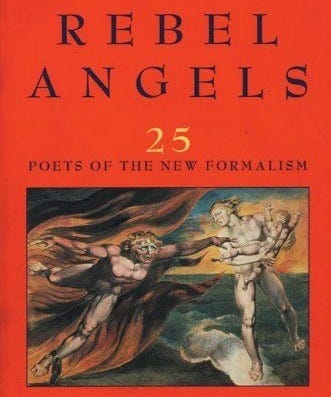
Rebel Angels. The ole’ New Formalism. I really don’t mean to be too hard on this book. I haven’t even finished the thing. Never could get very far with it. Every time I pick it up, it rejects me. I have a hard time even remembering a single poem from it; And I know I’ve read some multiple times.
Some of the stuff in Rebel Angels is alright, and some of it is the drizzling shits (i.e. Elizabeth Alexander.) But to be clear, I’m not exactly making the accusation of tastelessness that I started with. I was exaggerating a bit, but just a bit.
Which brings me to Dana Gioia, who’s featured in this collection. Pretty popular as far as poets go, and he seems like a nice guy. Genuine. And he seems to actually like poetry.
I must’ve read something like two dozen Gioia poems. But I swear I can’t remember a single one—not a one of ‘em stuck. Gioia seems like a good idea on paper. But the poems? Oof.
Now, two dozen poems is a drop in the bucket, so you won’t hear any definitive statements from me. I’ll give him another shot some time.
Anyway, here’s a poem of his featured in Rebel Angels.
~~~
Maze without a Minotaur

If we could only push these walls
apart, unfold the room the way
a child might take apart a box
and lay it flat upon the floor—
so many corners cleared at last!
Or else could rip away the roof
and stare down at the dirty rooms,
the hallways turning on themselves,
and understand at last their plan—
dark maze without a minotaur,
no monsters but ourselves.
                                          Yet who
could bear to see it all? The slow
descending spirals of the dust
against the spotted windowpane,
the sunlight on the yellow lace,
the hoarded wine turned dark and sour,
the photographs, the letters—all
the crowded closets of the heart.

One wants to turn away—and cry
for fire to break out on the stairs
and raze each suffocating room.
But the walls stay, the roof remains
strong and immovable, and we
can only pray that if these rooms
have memories, they are not ours.
~~~
Minotaurs, mazes, madness, melancholy, metaphor. This should be right up my alley. Like it’s got all my favorite things. This should appeal to me. But it doesn’t.
So I’m trying to figure out why it falls flat for me. I mean, it’s not a bad poem. It’s competently constructed. He plays out the poem’s idea. It sounds alright out loud. But it just doesn’t excite or interest me.
Some reasons why:
L3: “a child might take apart a box”. So, it’s a cardboard box, but you don’t really “take” apart a cardboard box; And a kid certainly doesn’t. I was a kid, I tore apart boxes, or cut them apart. “A child might tear apart a box” seems much better to me. “Take” is weak there. We were talking about perfect words earlier. Well here’s an imperfect word.
I know it’s a minor thing, but this is poetry! Scrutinizing every word is kinda the point. There’s more words like it. L7: “dirty rooms”. Why are they dirty? They’re crammed with old stuff, but not necessarily dirty. Why not “filthy” or “rancid” or “dingy”?
There’s a fair amount of simple, plain word choices. Which doesn’t have to be a bad thing, but here it comes out as weakness.
The verse is unrhymed, so you lose access to that avenue. The phonic echo is subtle. It’s only somewhat sonically engaging. The dearth of acoustic excitement shifts the impetus on to other things, which only accentuates the weakness of the weak word choices.
It’s tetrameter, which means less room for adjectives. Though he does ameliorate that by using enjambment. Which leads us to the poem’s Formalism. It’s written in regular iambic tetrameter. It’s metrically solid, which is its strongest aspect. (Along with the rooms as an unfolded cardboard box—the poem’s best image.)
L11: “no monsters but ourselves”.
Ugh…
Ten lines in, and I just haven’t bought in. Then when he hits L11—I’m out. The “We’re the real monsters” theme finds absolutely no purchase with me. Even in a very mild form like this, I have zero patience for it.
So there it is, probably the main reason this poem fails for me: There’s no Minotaur. Maze without a Minotaur? More like Poem without a Minotaur. There’s no there there.
We “ourselves” are the Minotaur, but we don’t act like it. The monster isn’t real. It doesn’t do any monster things. There’s no action. The speaker limp-wristedly wishes for this, wishes for that. He won’t set the fire on the stairs—won’t do nothing. There’s no drama. Add all this stuff up, and the poem lands flat.
I don’t really have any desire to continue the scrutiny. However, for the sake of thoroughness, and so that the reader doesn’t feel that I’m being capricious, I’ll finish the critique.
The diction register rises only just above plain speech, which is fine. But unlike other poets who do it well, like Robert Frost, this poem’s statement is not buried deep in the image. It’s floating on the top. Which is to say that the poem’s statement is not as artfully incorporated into it’s conceit as a Frost poem might be. As in “The Leaf Treader”, for instance.
The catalogue of objects in the middle part is nice, but cataloguing is overused, and over-relied on. But more to the point, this catalogue in particular uses less than striking elements.
“But the walls stay, the roof remains/strong and immovable,” is dull. Also, why do the walls stay? We want to “raze each suffocating room” but we can’t because the “walls stay”. The walls are passive and they don’t act on us or stop us. Their “plan” is to contain us in the maze. But how do they do it? Presumably we can’t act because “who could bear to see it all”. So, both the walls and ourselves are acting in mutual inaction.
We conclude this poem with “we/can only pray that if these rooms/have memories, they are not ours.” But we’ve spent the rest of the poem establishing that these rooms do have memories, and that those memories are indeed ours. Both “Yet who could bear to see it all?” and “all the crowded closets of the heart” establish these inferences.
If after all, the rooms do not trap us in our memories, just as the maze traps the minotaur, what was the point of the poem? And so the poem ends resolved to wish for an impossibility. All we can do is wish for things to not be as they are.
You can see that the poem’s conceit has promise. Our memories of the past, substantiated in that list of aged, worn-out objects, trap us in a maze just like the Labyrinth traps the Minotaur. But the poem doesn’t have enough follow-through to overcome its flaws. The take-off was good, but the plane doesn’t land.
Well, that’s enough of that.
Now, there happens to be a similar poem called “The Wolves” by Allen Tate. You can read my ramblings on it here.
They both have “a monster in the house.” (Though “Minotaur” feels like it’s urban—maybe an apartment building.) They are both about “Man confronting Man.”
But “The Wolves” is better. Stronger conceit, stronger words, stronger images, and a more expansive statement. “Minotaur” lacks the style and the guts to draw me in.
Post-Modernity
I think that Post-Modernity will finally, fully begin when Tradition has erotically devoured Modernity.
Recovering Tradition
Don’t bother to try recovering “tradition.” You’re resuscitating a corpse. You have to have more faith than that. A reminisced past is dead as an imagined future. Live in the present. And I mean the present, not the Right Now, the Immediate, or the Moment. The present in the terms of man, not the terms of angels or artifice.
The past is recapitulated in the present, and the present gives birth to the future. The past is the roots of the present. They are subterranean. They are unseen. And if you wish to remember the past, they are best remembered in the blossoms of tomorrow.
Whether you treat a sapling as a tree or a tree as sapling, you will kill it either way. Things are living. They are growing. If treated as dead, they will die.
You tend to things as they are. You can’t give birth in the past, nor give birth in the future. You can only give birth in the present. And regardless whether you desire birth in the past or birth in the future, you must pursue Eros in the present to achieve it.
To Be At Work; To Be At Theory
To be at Work is a flowing stream. To be at Theory is a sitting pond. Things must move and things must rest. However, rest too long and stagnate, or move too much and exhaust.
Both streams and ponds are bodies of water, just as Work and Theory are the same bodies, but differ in state. Same substance, different form.
It is difficult to think of Theory in the midst of Work. The Worker must first pause and then pull Theory in as if drawing from a reservoir. When the stream runs dry, the reservoir must supplement. For what is the purpose of a stream but to move?
Problems
I am unable to totally extricate myself from the moral and political concerns of today. As a man, I can accept this. For better or worse, it’d be inhuman to unburden oneself of these things.
However, what of poetry?
Will a poem solve a moral or a political problem? No.
Moral and political problems are solved by action. Reading a poem is non-action, and making a poem lies somewhere between action and not.
At base, problems of the world are solved by violence, the threat of violence, and the avoidance of violence.
Poems are provocation and seduction. They sit at the vestibule of violence.
Men solve worldly problems. Poems solve artistic problems. The Poet stands astride the gap between the two. By diverse stratagems, by trial and error, by hook or crook, he must do what he can to retain his balance.
However at the end of the day, a poem solves an artistic problem first and foremost.
Gargoyles
I have long considered my own poems to be gargoyles. They’re things that sit around and pull funny faces. They’re little monsters that, with a bit of luck, might scare away the big ones.